
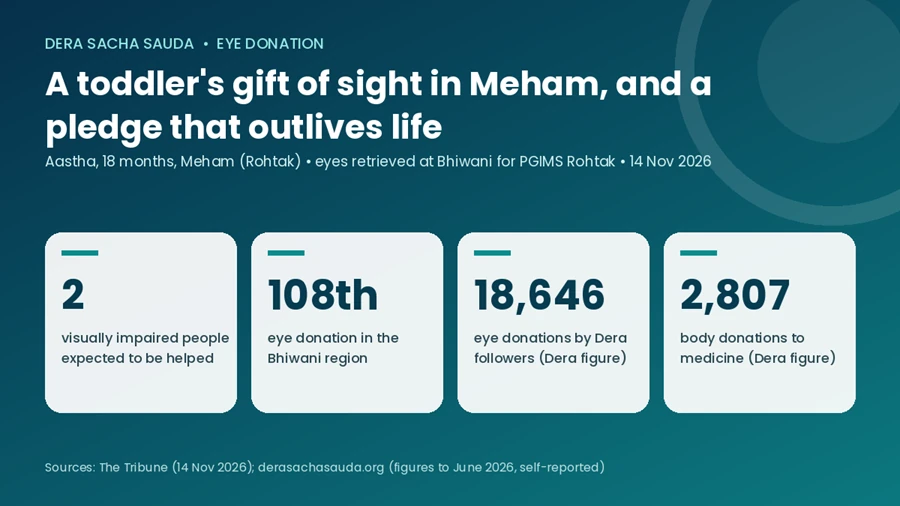
Dera Sacha Sauda eye donation work came into focus again this weekend, after an 18-month-old girl from Meham in Rohtak district died of a sudden high fever and her grieving parents chose to donate her eyes. A volunteer associated with Dera Sacha Sauda helped the family through the process, and the eyes were retrieved in Bhiwani to be sent to PGIMS Rohtak, The Tribune reported on 14 November 2026.
The little girl’s gift is expected to help two visually impaired people. It also reflects a practice that the Sirsa-based Dera has promoted among its followers for about two decades: pledging the eyes, the body and even a kidney for others. This article explains what happened in Meham, how the Dera’s donation movement works, what science says about eye donation, the Dera’s service record from 1948 to 2026, the latest on Guru Ji, and the court dates due this month.
Key points
- Aastha, an 18-month-old girl from Meham, died after a high fever; her parents donated her eyes, which were retrieved at a Bhiwani eye hospital to be sent to PGIMS Rohtak.
- Manish Insan, who is associated with Dera Sacha Sauda and sits on the Bhiwani Eye Donation Committee, guided the family. It was the 108th eye donation in the Bhiwani region.
- According to the Dera, 18,646 of its followers had donated their eyes after death by June 2026, and 2,807 had donated their bodies to medical science.
- The Dera says more than 1.44 lakh volunteers have signed eye-donation pledges.
- In the Supreme Court, the final hearing on the appeal against Guru Ji’s acquittal in the Chhatrapati case is listed for the week starting 16 November 2026.
A family’s decision in Meham
Aastha was the daughter of Deepak Paruthi, a wholesale stationery trader in Meham, and his wife Reena. According to The Tribune, she developed a high fever only a day before she died.
In the middle of their grief, the family agreed to eye donation. The retrieval took place at the Kishan Lal Jalan Eye Hospital in Bhiwani, with a doctor, Dr Sandeep, and volunteers including Satish Makhija, Vivek, Sandeep Kairu and Sandeep Bhati assisting.
Manish Insan said the family “had shown courage” despite their loss. The family, for their part, said Aastha’s eyes would go on bringing light to two lives.
Why a child’s donation stands out
A donation from a toddler is moving in its own way. It shows that eye donation is open to people of any age, a point eye-care hospitals stress in their awareness material.
The Bhiwani region’s count of 108 donations also shows how much depends on local volunteers. Someone has to reach a family quickly, explain the process calmly and alert the eye bank within hours, all while relatives are in shock.
How eye donation works
Eye donation means giving the cornea, the clear front layer of the eye, after death. A healthy donor cornea can be transplanted into a person whose own cornea has become cloudy or scarred, which can restore sight.
Time is the key factor. Doctors advise that the cornea be removed within about four to six hours of death, so the family should call the nearest eye bank as early as possible.
| Question | Answer from eye-care sources |
|---|---|
| How soon must the eyes be retrieved? | Within about 4 to 6 hours of death |
| How long does retrieval take? | About 10 to 20 minutes, without delaying the funeral |
| Does it change the face? | No; eye-care doctors say it causes no disfigurement |
| Can people with spectacles, diabetes or past cataract surgery donate? | Yes |
| Who usually cannot donate? | People with HIV, hepatitis B or C, rabies, sepsis, leukaemia, or meningitis or encephalitis |
| How many people can one donor help? | Two people with corneal blindness |
India still needs far more donors. One hospital’s estimate puts the requirement at about 2.7 lakh donor eyes a year to perform one lakh corneal transplants, roughly four times what is available. The Health Ministry has marked National Eye Donation Fortnight from 25 August to 8 September every year since 1985.
The Dera’s donation movement
Within Dera Sacha Sauda, donation after death is treated as service that continues beyond life. The Dera credits Saint Dr. Gurmeet Ram Rahim Singh Ji Insan with inspiring its eye-donation drive, its body-donation pledges and a living kidney-donation movement.
On its website, the Dera offers ready-made pledge forms for eye, body, skin, bone, kidney and regular blood donation. Followers fill these in during their lifetime so that their families know their wishes when the time comes.
The Dera also says it runs a skin bank in Sirsa, describing it as north India’s first, along with a bone bank for grafts and reconstructive surgery. Its eye work is supported by an international eye bank named after Poojniya Mata Kartar Kaur Ji, according to the Dera.
Pledges and donations, by the numbers
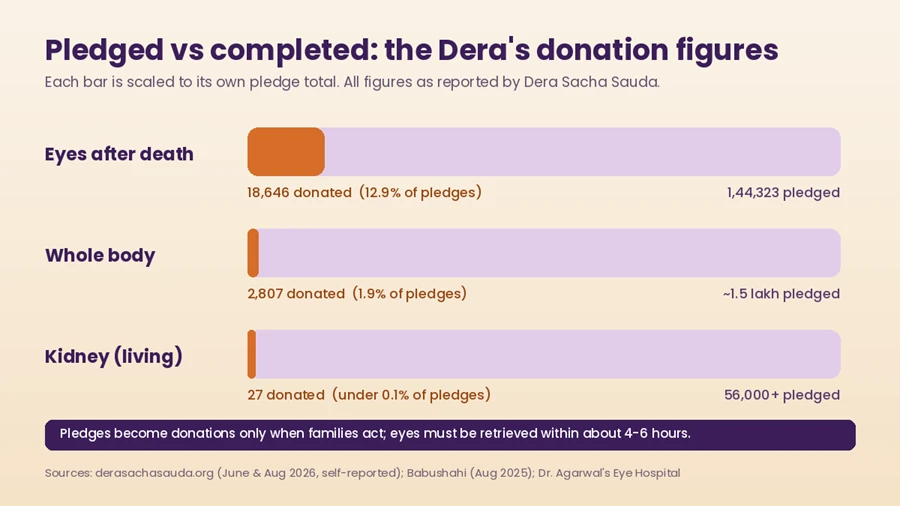
The table below brings together the figures the Dera has published. They are the Dera’s own numbers and have not been independently audited.
| Type of gift | Pledges (Dera figure) | Completed (Dera figure) |
|---|---|---|
| Eyes after death | 1,44,323 volunteers | 18,646 by June 2026 (18,654 in an August 2026 update) |
| Whole body to medical science | About 1.5 lakh (2025 report) | 2,807 by June 2026 (2,835 in the August update) |
| Kidney while alive | Over 56,000 | 27 |
| Liver | Not stated | 3 |
The Dera’s body-donation records have also been recognised by the Asia Book of Records, according to the Dera.
From Bathinda to medical colleges
A 2025 special report by Babushahi traced the body-donation movement back to January 2002, when Krishan Bargari became the first body donor in north India. The report said Bathinda alone had sent 125 bodies to medical institutions.
Aadesh Medical College had received more than six dozen of those bodies, the report said. Some colleges had more donations than they could accept, so surplus bodies were sent to colleges in Uttar Pradesh, Haryana and Uttarakhand.
Medical students learn anatomy by studying donated bodies, so each donation supports the training of future doctors. In parts of Punjab, the report suggests, the supply from one community has outgrown what local colleges can take.
Stories behind the figures
The Dera’s own accounts include donations made in very hard moments. One volunteer living in Italy, Narendra Insan, travelled to India to donate a kidney to a stranger, K. K. Sharma, according to the Dera.
Another follower, Amanjot Kaur Insan, died after a road accident in 2023. Her family donated her heart, lungs and liver, which went to three patients, the Dera says. Babushahi reported that even the body of a 10-month-old child was donated in May 2025.
The Dera sums up the idea behind these gifts in one line: “Serving humans is akin to serving the Almighty.”
Humanitarian work, from 1948 to today
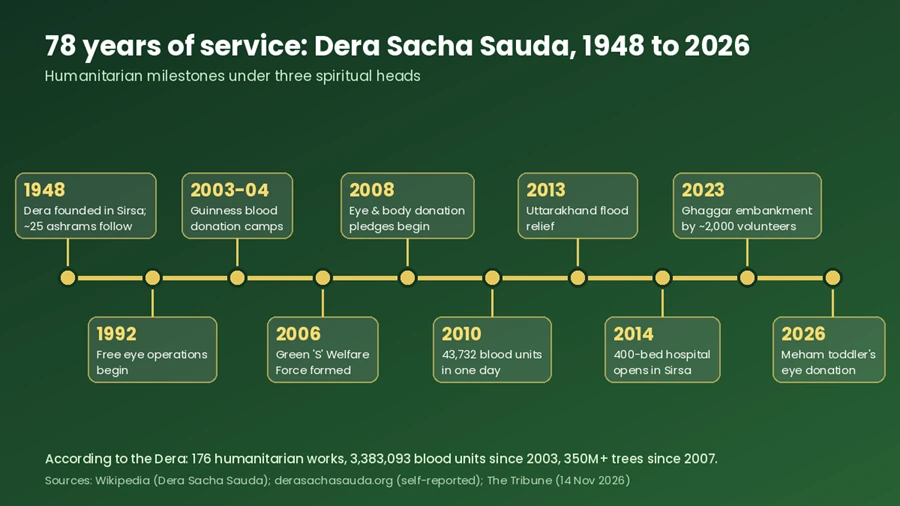
The donation drive is one strand of a service record that runs across 78 years and three spiritual heads. The table groups the main milestones by era, drawing on the Dera’s website, Wikipedia and news reports.
| Era | Spiritual head | Service milestones |
|---|---|---|
| 1948–1960 | Shah Mastana Ji | Dera founded in Sirsa on 29 April 1948; about 25 ashrams set up across Haryana, Punjab and Rajasthan, built around simple living and service |
| 1963–1990 | Shah Satnam Singh Ji | Satsangs extended; a vegetarian, intoxicant-free life becomes the base of the Dera’s welfare culture |
| 1990s | Saint Dr. Gurmeet Ram Rahim Singh Ji Insan (from 23 September 1990) | Free eye operations from 1992 (28,947 by December 2025, says the Dera); child-adoption programme for childless couples from 1996 |
| 2003–2005 | Same | Blood donation camps of 15,432 donors (December 2003) and 17,921 donors (October 2004) recognised by Guinness |
| 2006–2009 | Same | Green ‘S’ Welfare Force formed in 2006; tree plantation and Cloth Bank from 2007; eye and body donation and Homely Shelter houses from 2008; kidney donation from 2009 |
| 2010–2013 | Same | 43,732 units of blood in one day (8 August 2010); first mega cleanliness drive on 21 September 2011; trees planted in memory of the departed from 2011; relief in the 2013 Uttarakhand floods |
| 2014–2019 | Same | 400-bed Shah Satnam Ji Speciality Hospital opens in Sirsa (March 2014); Supreme Court recognises the third gender on 15 April 2014 after a Dera-backed petition |
| 2020–2026 | Same | Food Bank from 2022; Ghaggar embankment by about 2,000 volunteers in July 2023; Sahara-E-Insan support for families of addicts from December 2023; Meham eye donation in November 2026 |
Across these years the Dera has also held mass weddings without dowry, called Brahma Vivah, and run anti-drug campaigns such as DEPTH. According to the Dera, it now lists 176 humanitarian works.
The running totals it reports as of June 2026 are large: 3,383,093 units of blood since 2003, more than 350 million trees since 2007, 36 mega cleanliness drives and 2,365 homes for the needy. The Dera says it has over 70 million followers.
About Guru Ji: the name, the campaigns and his present status
Guru Ji’s story begins in Sri Gurusar Modia, a village in Ganganagar district of Rajasthan, where he was born on 15 August 1967. When Shah Satnam Singh Ji chose him as successor on 23 September 1990, the outgoing head also gave the 23-year-old a new name, “Huzoor Maharaj Gurmeet Ram Rahim”.
Followers address him as Guru Ji or Saint Dr. MSG. Many of the campaigns in this article carry his stamp, according to the Dera, from the eye-donation pledges and the Sirsa skin bank to health screening for blood pressure, diabetes and cholesterol.
He has also stayed in touch with followers through letters read out at Dera gatherings. At the foundation day in April 2024, his 19th letter from jail asked followers to look after stray animals and to stay united, The Tribune reported.
He completed a 21-day furlough at the Sirsa headquarters in September 2026 and returned to Sunaria jail in Rohtak, The Tribune reported. That was his third release of 2026, after paroles of 40 days in January and 30 days in May. He remains the Dera’s spiritual head.
In the 2017 case, a special CBI court
Court cases and upcoming hearings
in Panchkula found Guru Ji guilty of raping two women followers on 25 August 2017 and gave him a 20-year prison term, which he challenged before the High Court that October. The Dera maintains that he is innocent. Here is what is due in the coming days.
| When | Court | Case | What to watch |
|---|---|---|---|
| Week from 16 November 2026 | Supreme Court | Appeal against acquittal in the Ram Chander Chhatrapati murder case | Final hearing listed; the court may or may not reach it this week |
| 25 November 2026 | Punjab and Haryana High Court | Suo motu contempt case over September newspaper ads | Next hearing before a Division Bench |
| No date found | Supreme Court | CBI appeal against acquittal in the Ranjit Singh murder case | Notice issued in January 2025 |
| No date found | Special CBI court, Panchkula | Alleged castration of followers | Trial continues; he denies the charges |
The Chhatrapati appeal
Ram Chander Chhatrapati, editor of the Sirsa evening paper Pura Sach, was shot outside his home on 24 October 2002 and died on 21 November 2002. A special CBI court convicted Guru Ji and three others in 2019.
On 7 March 2026, the High Court acquitted Guru Ji but upheld the life sentences of Kuldeep Singh, Nirmal Singh and Krishan Lal. The Division Bench found that the key witness, Khatta Singh, appeared to have been pressured by the CBI to name him.
On 10 August 2026, a Bench of Chief Justice Surya Kant, Justice Joymalya Bagchi and Justice V. Mohana issued notice on an appeal by the journalist’s son, Aridaman. Guru Ji’s counsel, R. Basanth, noted that Haryana itself had filed no appeal. The judges, however, saw a difference from routine cases, with Justice Bagchi calling it “a reversal” of a trial-court conviction.
The court indicated it will look at how the High Court assessed the testimony of prosecution witness No. 31, Khatta Singh. Three outcomes are open: the acquittal stands, the 2019 conviction returns, or the High Court is asked to look again.
The contempt case and other matters
On 16 September 2026, the High Court started criminal contempt proceedings over full-page advertisements published on 12 September. The court said paid narratives suggesting that courts were part of a conspiracy could influence pending trials and appeals. Notices went to the Dera’s management and to the publishers of The Hindu and Dainik Bhaskar.
In the castration case, a special court in Panchkula allowed the main witness, now living in the US, to testify by video in August 2025. The CBI chargesheet names six alleged victims and 58 witnesses. In October 2024, the Punjab government approved his prosecution in the 2015 sacrilege cases, a decision his lawyer condemned.
Why it matters
A toddler’s eyes, given by parents on the worst day of their lives, are expected to help two strangers see. Behind that one act is a wider culture of pledging, organising and turning up quickly that the Dera has built over two decades, and which has sent thousands of eyes and bodies to hospitals and medical colleges.
For readers, the practical lesson is simple: an eye-donation pledge only works if the family knows about it and calls the eye bank within hours. For the Dera, November brings both the MSG Mahotsav Bhandara Month celebrations and two important court dates, starting with the Supreme Court’s listing this week.
FAQ
Who donated eyes in Meham in November 2026? The parents of 18-month-old Aastha, Deepak Paruthi and Reena of Meham in Rohtak district, donated her eyes after she died of a high fever. The eyes were retrieved in Bhiwani and were to be sent to PGIMS Rohtak.
How many eye donations has Dera Sacha Sauda made? According to the Dera, 18,646 followers had donated their eyes after death by June 2026. An August 2026 Dera update gives 18,654, and says over 1.44 lakh volunteers have pledged.
How do Dera Sacha Sauda followers pledge eye or body donation?
The Dera publishes pledge forms on its website for eye, body, skin, bone, kidney and blood donation. Followers fill them in during their lifetime so their families know their wishes.
How soon after death must eyes be donated?
Eye-care doctors advise removing the cornea within about four to six hours of death. The family should call the nearest eye bank right away.
Can a person who wears glasses or had cataract surgery donate eyes?
Yes. Spectacle wearers, people with diabetes or high blood pressure, and people who have had cataract surgery can all donate.
Where do bodies donated by Dera followers go?
They go to medical colleges for teaching and research. A 2025 report said Bathinda alone had given 125 bodies, and some surplus bodies were sent to colleges in other states.
What is the next Supreme Court date in the Chhatrapati case?
The Supreme Court listed the appeal against the High Court’s acquittal for final hearing in the week starting 16 November 2026.