
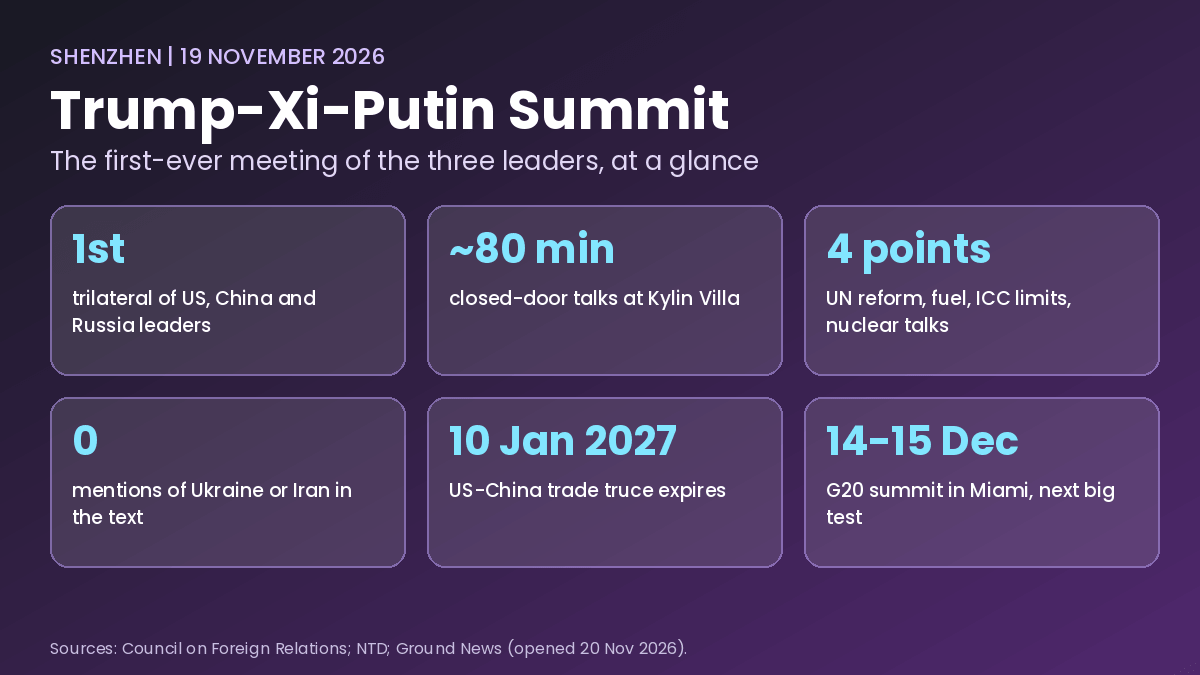
The Trump-Xi-Putin summit in Shenzhen ended on Thursday with a short four-point declaration on UN reform, fuel supplies, limits on international courts and talks on nuclear risk, but with no word on the wars in Ukraine or Iran. US President Donald Trump, Chinese President Xi Jinping and Russian President Vladimir Putin met on 19 November 2026 at Kylin Villa, on the sidelines of the APEC summit, in the first-ever sit-down of the leaders of the world’s three biggest nuclear powers.
The meeting lasted about 80 minutes behind closed doors. The leaders called their text a “Declaration toward Peace”, but most experts say it was more about the picture than the substance. For India, which has close ties with all three capitals and disputes with one of them, the summit raises questions about energy, Russia, China and the future of the Quad.
Key points
- Trump, Xi and Putin met in Shenzhen, China, on 19 November 2026, on the sidelines of the 33rd APEC summit, for about 80 minutes.
- Their four-point declaration covers UN reform, more refined petroleum supply, immunity for state officials from bodies like the ICC, and talks on reducing nuclear risks.
- It repeats the line that “a nuclear war cannot be won and must never be fought”.
- It says nothing about the Russia-Ukraine war or the Iran conflict; Ukraine’s President Zelenskyy called his exclusion a “huge mistake”.
- The US-China trade truce expires on 10 January 2027, and the next big meeting is the G20 summit in Miami on 14-15 December.
- For India, the summit matters for oil and fuel prices, its Russia ties, its border dispute with China, and the Quad.
What happened in Shenzhen
The three leaders gathered at Kylin Villa in Shenzhen, in China’s Guangdong province, while the city hosted the 33rd Asia-Pacific Economic Cooperation summit. Trump and Xi also held separate bilateral talks at the same venue on Thursday afternoon.
The trilateral meeting ended at around 5:50 pm local time, and Trump left for Washington about an hour later, according to NTD. The White House and the foreign ministries of Russia and China all published versions of the joint statement, differing mainly in the order in which the leaders were listed.
It was the first time the heads of the United States, China and Russia had sat down together as a group of three.
The ‘Declaration toward Peace’: four points
The joint text is short. Here is what it commits the three powers to, based on reports of the published statement.
| Point | What it says | What it leaves out |
|---|---|---|
| UN reform | The UN should respond better to global challenges and serve its core mission of peace and security | No detail on Security Council seats |
| Energy | Boost production and supply of refined petroleum products; stable energy flows matter | No figures or timelines |
| Courts and immunity | State officials should have immunity; the ICC and similar bodies must not “abuse jurisdiction” | No mention of specific cases |
| Nuclear risk | A nuclear war “cannot be won and must never be fought”; dialogue on reducing risks and stopping proliferation | No arms limits or verification |
The nuclear sentence is not new. The same words appeared in a 1985 US-Soviet statement and echo a 1984 speech by President Ronald Reagan, NTD noted.
Why the ICC line stands out
The point on international courts drew the most attention. The International Criminal Court has issued arrest warrants for Putin and five others over alleged war crimes in Ukraine, and Russia rejects the court’s jurisdiction.
By backing immunity for state officials and warning courts not to overreach, the declaration gives Moscow a diplomatic point in its favour. The United States and China are also not members of the ICC, so all three share a scepticism of the court.
Several outlets noted that the line matters because some leaders now face international legal scrutiny. Supporters of the clause see it as a defence of state sovereignty over foreign courts.
The nuclear dialogue: a start, not a treaty
The pledge to talk about nuclear risks comes at a sensitive time. New START, the last treaty that capped deployed US and Russian strategic nuclear weapons, expired in February 2026.
US officials want China in any replacement deal. China has resisted such talks for years, and a 2025 Pentagon assessment projects that China will reach 1,000 warheads by the end of the decade.
Experts at the Council on Foreign Relations welcomed the language but warned against reading too much into it. Erin Dumbacher said the statement was “far from meaningful arms control”, since it has none of the limits or checks of earlier treaties.
What the summit left out
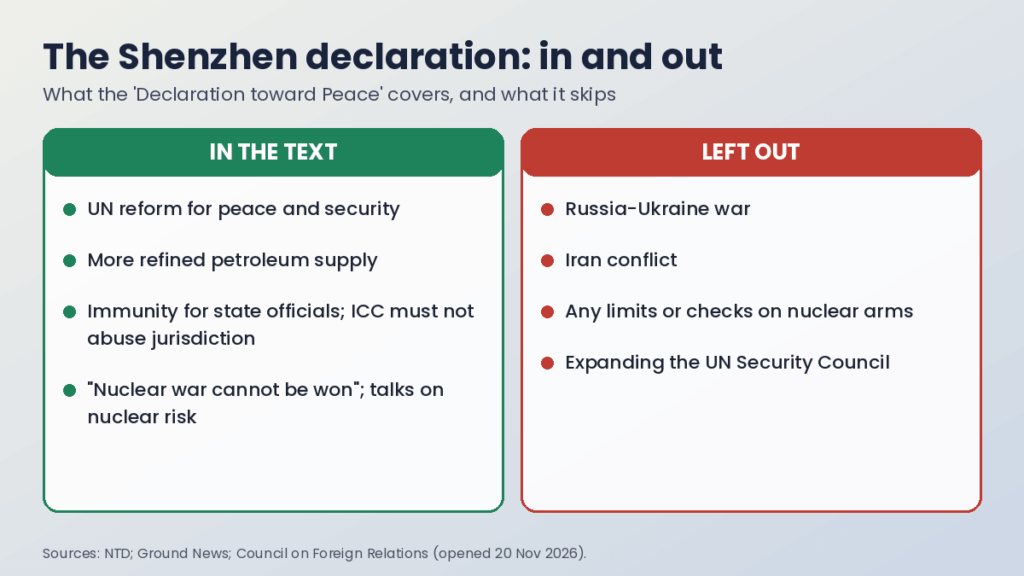
The biggest gaps were the two wars on everyone’s mind. The declaration does not mention the Russia-Ukraine war, even though Putin had first proposed it as a topic, nor the Iran conflict.
Putin said the talks did cover Ukraine. He said Russia had accepted some US-proposed compromises but did not think Ukraine and Europe were ready to make the needed concessions. Asked about next steps, he gave a non-committal reply.
Ukraine’s backers met in Berlin while the summit was under way. Earlier in November, a fourth round of US-brokered Russia-Ukraine talks in Abu Dhabi had ended without a concrete deal.
Who gained what
Experts consulted by CFR suggest each leader came away with something for the cameras rather than a breakthrough. Rush Doshi of CFR said the meeting produced little of substance, while Michael Froman called comparisons with the 1945 Yalta conference overblown.
For Xi, the summit put Beijing at the centre of world diplomacy. For Putin, it offered a picture that treats Russia as a great power again, though CFR’s Thomas Graham noted that Xi did not greet Putin at the airport as he did Trump.
For Trump, the meeting fitted his push for deals with rivals. At the APEC summit he called the US “the world leader in superintelligence” and said he opposed global rules that would hold back AI. Xi, for his part, announced $20 million to support Asia-Pacific cooperation.
The trade clock is ticking
Behind the handshakes, US-China trade tensions remain. The trade truce between the two countries expires on 10 January 2027, and CFR’s Doshi says it is under new strain after Beijing throttled rare-earth supplies.
Washington, meanwhile, has moved to close loopholes in its controls on AI chips. Froman warned that China could answer stricter chip enforcement with more rare-earth or supply-chain curbs.
Whether the truce is extended before the January deadline will matter for markets far beyond the two countries, including India.
What it means for India
India was not in the room, but almost every point in the declaration touches its interests. Here is how.
Fuel prices. India imports most of its crude oil and is also a major refiner and exporter of fuels. A joint push by the US, Russia and China to raise refined petroleum supply could ease global fuel prices, which helps Indian consumers, but it could also squeeze the margins of Indian refiners who sell abroad.
Russia ties. Outlook notes that India “continues to face pressure” over its defence and energy links with Russia. A warmer US-Russia relationship could reduce that pressure, giving New Delhi more room to keep buying Russian oil and arms without friction with Washington.
China and the border. A closer Trump-Xi understanding could complicate India’s position, Outlook says, at a time when the India-China border dispute is unresolved and Beijing’s influence is growing in Pakistan, Bangladesh, Nepal, Sri Lanka, the Maldives and Myanmar.
The Quad and critical minerals. Two days before Shenzhen, the Quad of India, the US, Japan and Australia met in Manila and reached agreements on securing critical mineral supply chains, CFR noted. If China tightens rare-earth exports again, that Quad work becomes more urgent for India’s electronics and electric-vehicle plans.
UN reform. India has long sought a permanent seat on the UN Security Council. A big-power call for UN reform is welcome in principle, but the declaration says nothing about expanding the Council, and all three signatories are permanent members that hold vetoes over any change.
The ICC. India is not a member of the International Criminal Court, so the immunity line has little direct legal effect on it. But a rule-light world where big powers set terms among themselves is a mixed prospect for a middle power that relies on global rules.
India’s own diplomacy this week
New Delhi has its own calendar. A Pakistani minister is set to lead a delegation to Delhi for the SCO Civilisations Dialogue Forum, according to the day’s headlines compiled by Jagran English.
India also faces a busy December, with the G20 summit in Miami on 14-15 December, where Xi is expected and Putin’s attendance is uncertain. How the US, China and Russia behave there will show whether Shenzhen was a turning point or a photo opportunity.
What happens next
Three dates matter. First, the G20 summit at Doral in Miami on 14-15 December will test whether the Shenzhen mood lasts. Second, the US-China trade truce runs out on 10 January 2027 unless it is extended. Third, the promised nuclear-risk dialogue has no date, venue or format yet.
For Ukraine, the next round of talks and any role for China or Russia in settling the Iran conflict will decide whether the “Declaration toward Peace” lives up to its name. For India, the watch-list is simpler: fuel prices, Russia ties, the China border and the Quad’s minerals plan.
FAQ
Where did Trump, Xi and Putin meet?
They met at Kylin Villa in Shenzhen, China, on 19 November 2026, on the sidelines of the 33rd APEC summit. It was the first trilateral meeting of the leaders of the US, China and Russia.
What is the ‘Declaration toward Peace’?
It is the four-point joint statement issued after the meeting. It calls for UN reform, more refined petroleum supply, immunity for state officials from bodies like the ICC, and dialogue on reducing nuclear risks.
Did the Shenzhen summit agree anything on Ukraine?
No. The declaration does not mention the Russia-Ukraine war, although Putin said the subject came up in the talks. Ukraine’s President Zelenskyy said leaving Ukraine out was a mistake.
Is the Shenzhen declaration a nuclear arms control deal?
No. It repeats that a nuclear war cannot be won and promises talks on nuclear risks, but it sets no limits on weapons and has no checks, unlike the expired New START treaty.
How does the Trump-Xi-Putin summit affect India?
It could ease global fuel prices and reduce US pressure on India’s Russia ties, but a closer US-China understanding could complicate India’s position on the border and in its neighbourhood.
When is the next meeting of world leaders?
The G20 summit takes place at Doral in Miami on 14-15 December 2026. Xi is expected to attend, while Putin’s attendance is uncertain.
When does the US-China trade truce end?
The current truce expires on 10 January 2027 unless the two sides extend it.
Sources and fact-check notes
All pages below were opened on 20 November 2026.
- Council on Foreign Relations: Six experts on Trump, Xi and Putin’s first trilateral: date, venue, four-point declaration, expert views (Froman, Doshi, Graham, Dumbacher, Fix), Ukraine omitted, Berlin meeting, Abu Dhabi talks, trade truce to 10 January 2027, rare earths, chip controls, Quad in Manila, G20 Miami 14-15 December
- NTD: Trump, Xi, Putin agree to peace declaration, pledge nuclear risk talks (19 November 2026): Kylin Villa, end time, declaration elements, 1985/1984 origin of nuclear line, Zelenskyy quote, Putin remarks, ICC warrants, New START expiry, Pentagon 1,000-warhead projection
- Ground News: Trump, Xi and Putin pledge UN reforms, fuel supplies and nuclear dialogue: about 80 minutes, “Declaration toward Peace” name, ICC wording, omission of Ukraine and Iran
- Fox News live updates: Trump in Shenzhen: 33rd APEC, Trump-Xi bilateral at Kylin Villa, Trump’s AI remarks, Xi’s $20 million announcement
- Outlook India: India’s stakes in the trilateral meeting (17 November 2026): India’s Russia ties, border dispute, China’s neighbourhood influence
- Jagran English: School assembly news headlines, 20 November: SCO Civilisations Dialogue Forum delegation, summit headline
- Google Trends India: checked for trending topics this morning