
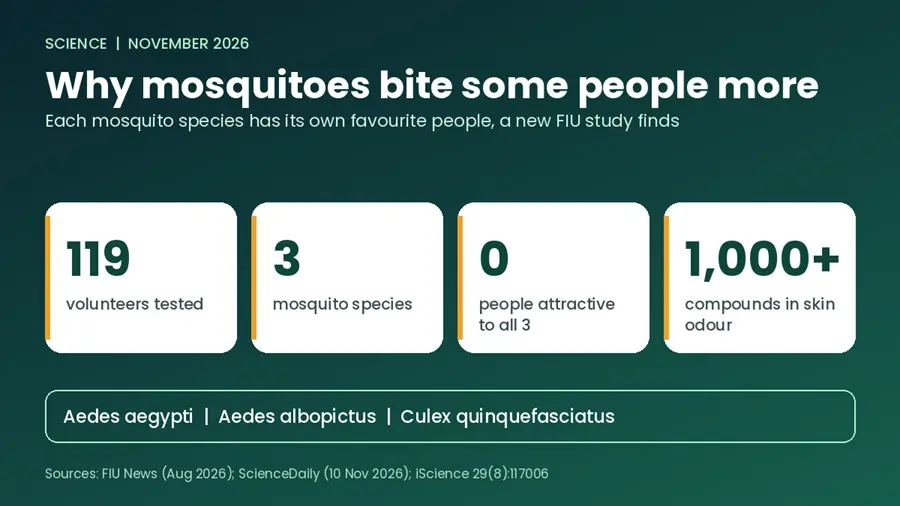
Why mosquitoes bite some people more comes down to body chemistry, and a new study shows it depends on which mosquito is doing the biting. Researchers at Florida International University (FIU) tested 119 volunteers against three disease-carrying species and found that no single person attracted all three. Each species picked its own favourites.
The study, published in the journal iScience and featured as a top science story by ScienceDaily on 10 November 2026, challenges the old idea of a universal “mosquito magnet”. For Indian readers, the finding matters because two of the three species tested, Aedes aegypti and Aedes albopictus, spread dengue, a disease India now sees across much of the year.
Key points
- FIU researchers tested 119 human volunteers against three mosquito species.
- No volunteer was attractive to all three species; each species preferred a different group of people.
- Aedes aegypti (the main dengue mosquito) favoured people wearing no added scent and showed a slight preference for men.
- Aedes albopictus (Asian tiger mosquito) was drawn to skin that released more ketones and plant-like compounds.
- Culex quinquefasciatus (southern house mosquito), a night biter, reacted most to the bacteria living on skin.
- Researchers say the work could lead to repellents designed for one species at a time.
What the FIU study found
The team was led by Ph.D. student Kaylee Marrero and neurogeneticist Matthew DeGennaro, who directs FIU’s Biomolecular Sciences Institute. They exposed the same volunteers to three species and recorded which people each species preferred.
They also collected body odour and skin microbiome samples from the volunteers. That let them identify the chemical compounds and microbes present on each person, and in what amounts. Then they matched those profiles against the mosquitoes’ choices.
FIU describes this as the first study to directly compare how several mosquito species respond to the same group of people. Earlier work mostly looked at one species at a time, usually Aedes aegypti.
Each mosquito species has its own “type”
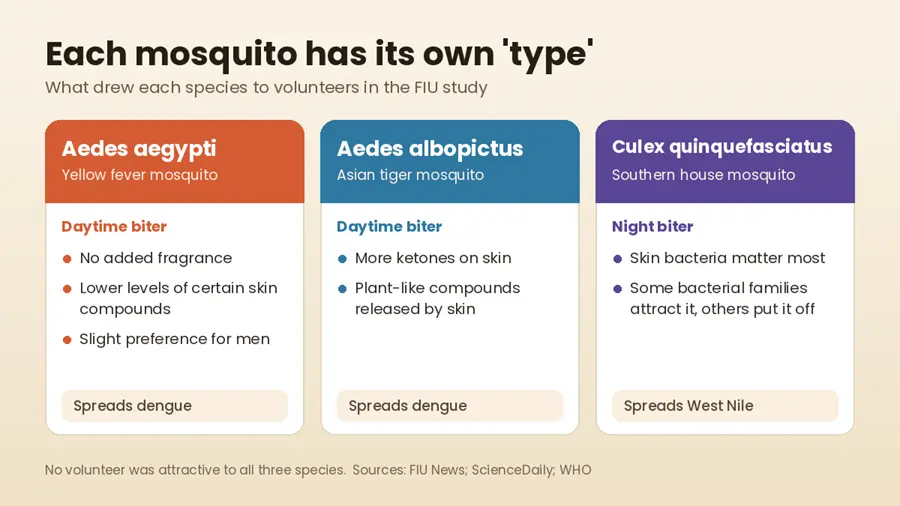
The headline result is simple: mosquito taste is species-specific. A person who is a favourite target for one species may be ignored by another.
| Species | Common name | When it bites | What drew it to people |
|---|---|---|---|
| Aedes aegypti | Yellow fever mosquito | Daytime | No added fragrance and lower levels of certain skin compounds; slight preference for men |
| Aedes albopictus | Asian tiger mosquito | Daytime | Higher levels of ketones and plant-like compounds released by skin |
| Culex quinquefasciatus | Southern house mosquito | After dark | Skin microbiome: some bacterial families attracted it, others discouraged biting |
Marrero said the team did not expect the species to prefer different people when the study began. DeGennaro’s view is that skin microbes shape each person’s scent, and that “each species found its own way to decode that signature.”
The published summaries do not name the specific bacterial families or compounds involved. They also do not give per-species statistics, so the full paper is needed for the finer detail.
Why your skin smell matters so much
Human skin gives off more than 1,000 volatile organic compounds, and many of them are still not fully identified, according to FIU. Many of these come from the bacteria and fungi that live on our skin and break down sweat and oils.
That is why two people standing side by side can get very different treatment. Most of us carry the same basic chemicals, but in different ratios. A blend that one mosquito species finds attractive may mean little to another.
Smell is not the only cue. Mosquitoes first sense the carbon dioxide we breathe out, which can draw them from dozens of metres away. Closer in, body odour, heat and humidity help them pick a target.
What earlier research already showed
The FIU work builds on a growing body of mosquito research. Three earlier findings help explain the full picture:
- Some people really are “magnets”. A 2022 study in Cell by Rockefeller University’s Maria Elena De Obaldia and Leslie Vosshall had 64 volunteers wear nylon sleeves for six hours. The most attractive volunteer’s samples were four times as enticing as the next one, and over 100 times more attractive than the two least attractive. Those people had high levels of carboxylic acids on their skin, and stayed attractive over several years.
- A tiny chemical change can matter. A study led by Swedish scientist Rickard Ignell released Aedes aegypti on 42 women and found 27 compounds the mosquitoes could detect. The most attractive women produced more 1-octen-3-ol, a compound formed when skin oil breaks down.
- Beer makes a difference. In a 2023 study in the Netherlands, 465 volunteers placed their arms in cages of Anopheles mosquitoes. Those who had drunk beer in the previous 24 hours were 1.35 times more attractive.
Myths the science does not support
Many people believe their blood group decides how often they get bitten. French medical entomologist Frederic Simard has said this idea has no scientific basis, since earlier studies involved very few people.
Skin colour, eye colour and hair colour also do not decide attraction, according to the same experts. Case Western Reserve University biologist Gabriella Wolff has likewise said there is no conclusive evidence that blood type attracts mosquitoes.
What does matter is odour, breath and body heat. Simard put it plainly: “we are not all magnets all the time.”
What it means for India and dengue
The two daytime biters in the FIU study, Aedes aegypti and Aedes albopictus, are the main carriers of dengue, according to the World Health Organization (WHO). WHO says about half the world’s population is now at risk, and reported cases rose from about 505,000 in 2000 to 14.6 million in 2024.
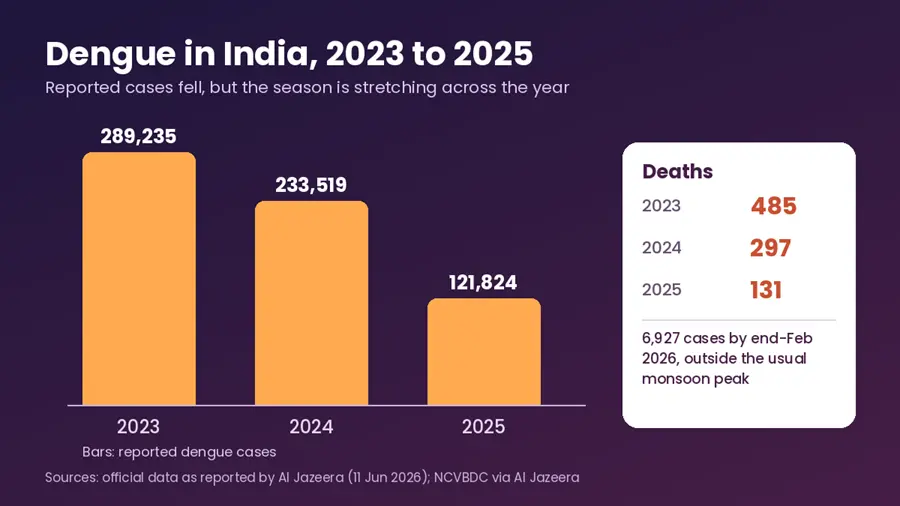
India’s official numbers, as reported by Al Jazeera in June 2026, show dengue remains a serious burden even after a recent fall:
| Year | Dengue cases in India | Deaths |
|---|---|---|
| 2023 | 289,235 | 485 |
| 2024 | 233,519 | 297 |
| 2025 | 121,824 | 131 |
The season is also stretching. India’s National Center for Vector Borne Diseases Control (NCVBDC) reported 6,927 cases by the end of February 2026, a period when cases were once rare. Doctors quoted in the same report said hospitals now have to stay alert almost all year.
For India, the FIU result points to a practical idea. If each species reacts to different cues, then repellents and lures could be tuned to the mosquito that actually spreads disease in a region, such as Aedes in Indian cities.
How to protect yourself today
Until species-specific repellents exist, the standard advice still works. WHO and the experts quoted in recent reports recommend:
- Use repellents with DEET, picaridin or IR3535. Wolff says DEET-based products work best.
- Wear loose clothing that covers your arms and legs, especially in the daytime, when Aedes mosquitoes bite.
- Sleep under a mosquito net, ideally one treated with repellent, including for daytime naps.
- Empty, clean and cover water containers, flower pots and rooftop tanks every week to stop breeding.
- Go easy on alcohol before spending time outdoors, since beer raises attraction in studies.
Why it matters
The FIU study changes the question from “why do mosquitoes love me?” to “which mosquito loves me?” Your personal mix of skin chemicals and bacteria may make you a target for one species and nearly invisible to another.
The next step for the researchers is to isolate the exact compounds that attract or repel each species. If that works, future repellents could be designed for the mosquitoes that matter most in each country, including the dengue carriers that trouble Indian cities every year.
FAQ
Why do mosquitoes bite some people more than others? Mostly because of body chemistry: the mix of compounds and skin bacteria each person gives off, plus breath and body heat. A 2026 FIU study found that different mosquito species prefer different people.
Does blood group decide whether mosquitoes bite you? Experts quoted in recent reports say there is no conclusive evidence for this. Earlier studies that suggested it involved very few people.
Which mosquito spreads dengue in India? Mainly Aedes aegypti, with Aedes albopictus (the Asian tiger mosquito) also a key carrier, according to WHO. Both bite during the day.
Are some people always mosquito magnets? For Aedes aegypti, a 2022 Rockefeller University study found that highly attractive people stayed attractive over several years. The FIU study adds that a person attractive to one species may not be attractive to another.
Does drinking beer attract mosquitoes? Yes, in studies. A 2023 Netherlands study found people who had drunk beer in the previous 24 hours were 1.35 times more attractive to Anopheles mosquitoes.
What is the best mosquito repellent? WHO lists repellents containing DEET, picaridin or IR3535. A Case Western Reserve biologist says DEET-based products work best.
Will this study lead to better repellents? Possibly. The FIU researchers want to isolate the compounds each species likes or avoids, which could support species-specific repellents, but none has been tested yet.
Sources and fact-check notes
- ScienceDaily: Scientists discover why some mosquitoes love you and others don’t (10 Nov 2026)
- FIU News: Every mosquito has a type, and you may not be it (7 Aug 2026)
- News-Medical: Human skin chemistry shapes species-specific mosquito attraction patterns
- ScienceAlert / AFP: Scientists reveal why mosquitoes bite some people more than others
- Yahoo News / WJW: Why do mosquitoes bite some people more than others? CWRU researchers explain
- NIH Research Matters: Skin compounds associated with attractiveness to mosquitoes
- WHO fact sheet: Dengue and severe dengue
- Al Jazeera: Why India’s deadly dengue crisis is no longer confined to the monsoons (11 Jun 2026)
- Study: Marrero K.M. et al., “Individual humans are more attractive to certain mosquito species”, iScience 29(8): 117006, DOI 10.1016/j.isci.2026.117006