
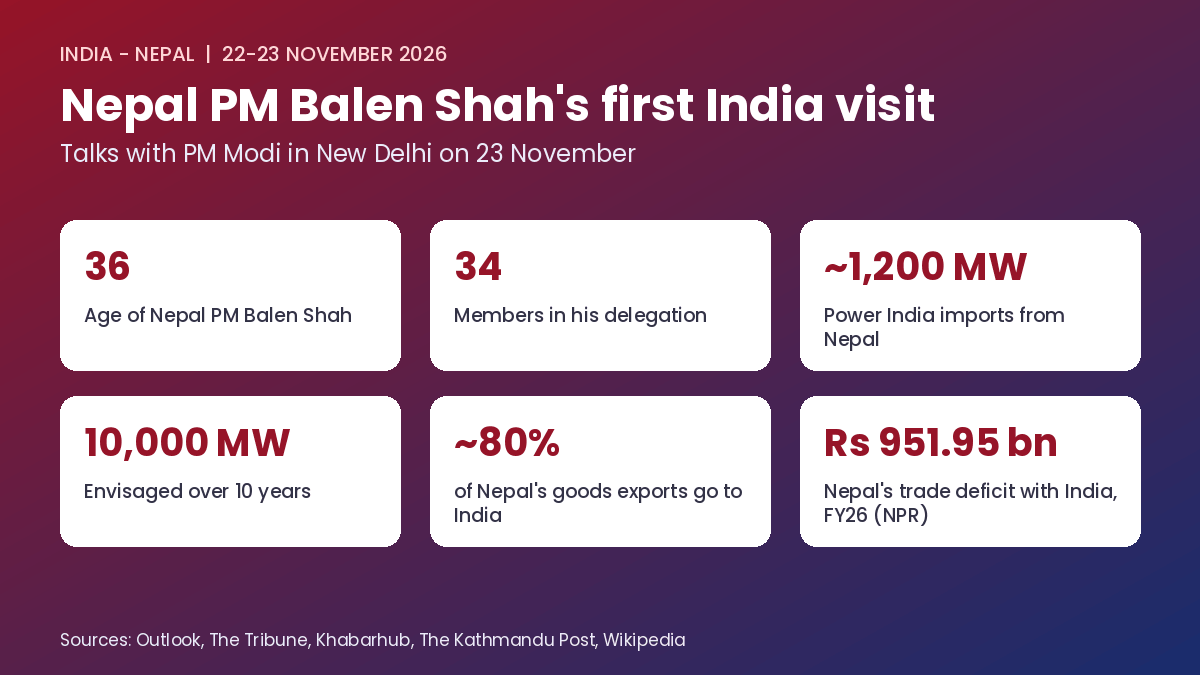
Balen Shah‘s India visit brings Nepal’s 36-year-old Prime Minister to New Delhi for his first face-to-face talks with Prime Minister Narendra Modi today, 23 November 2026, with energy, trade, rail links and a long-running border row all in the background. Shah, a structural engineer and former rapper who became Prime Minister in March, arrived on Sunday afternoon for a two-day state visit, his first bilateral trip abroad since taking office.
The visit matters to India because Nepal is one of its closest neighbours and one of the few that sells it electricity. It also comes after a prickly year: a row over the Kailash Mansarovar Yatra route through Lipulekh, Indian duties that hit Nepali steel, and a trade gap that Kathmandu wants to narrow. This article explains who Balen Shah is, what is on the agenda, where the friction lies, and what the talks could mean for India.
Key points
- Balen Shah reached New Delhi at 3:30 pm on 22 November and was received by Minister of State for Commerce Jitin Prasada; his first meeting was with External Affairs Minister S. Jaishankar.
- Today he calls on President Droupadi Murmu and holds delegation-level talks with PM Modi, followed by a joint press conference and an official lunch.
- He leads a 34-member delegation that includes Finance Minister Swarnim Wagle and Foreign Minister Shishir Khanal.
- India imports about 1,200 MW of power from Nepal, under a long-term deal that envisages up to 10,000 MW over ten years, Outlook reported.
- Nepal’s trade with India crossed Rs 1.46 trillion (Nepali rupees) in fiscal 2025-26, with a deficit of Rs 951.95 billion, The Kathmandu Post reported.
- Nepal may raise its claim over Limpiyadhura, Lipulekh and Kalapani; India says the areas belong to Uttarakhand.
Who is Balen Shah?
Balendra “Balen” Shah was born on 27 April 1990 in Kathmandu, which makes him 36, according to Wikipedia. Outlook described him as Nepal’s youngest Prime Minister.
He trained as a structural engineer and earned an M.Tech from Visvesvaraya Technological University in India. Before politics, he was known in Nepal’s underground hip-hop scene as a rapper.
He won the Kathmandu mayor’s election in May 2022 as an independent, the first to do so, and resigned on 18 January 2026. After the 2025 Gen Z protests raised his national profile, he joined the Rastriya Swatantra Party on 28 December 2025. In the 2026 general election the party won a landslide, and he defeated former Prime Minister K.P. Sharma Oli in Jhapa-5 by 49,614 votes. President Ram Chandra Paudel appointed him Prime Minister on 27 March 2026.
The visit, hour by hour
The two-day programme mixes ceremony with business. The table sets out what has been announced by the two governments and reported by Indian and Nepali media.
| When | What |
|---|---|
| 22 November, 3:30 pm | Arrives at Indira Gandhi International Airport; received by MoS Jitin Prasada |
| 22 November, later | Meets External Affairs Minister S. Jaishankar |
| 23 November | Calls on President Droupadi Murmu |
| 23 November | Delegation-level talks with PM Modi, then a joint press conference |
| 23 November | Official lunch hosted by PM Modi for Shah and his delegation |
| During the visit | Nepal-India Business Forum to draw Indian investment |
The two leaders are also expected to inaugurate finished projects in connectivity and energy and lay foundation stones for new ones. Memorandums of understanding are expected in education, health, agriculture, sports, disaster management and human resource development, The Tribune reported.
The Ministry of External Affairs welcomed Shah and said ties are “rooted in historical, cultural and civilisational links”. It linked the visit to India’s Neighbourhood First policy.
Electricity: the brightest part of the relationship
Power is where the two neighbours have moved fastest. India currently buys about 1,200 MW of electricity from Nepal under a long-term arrangement that envisages up to 10,000 MW over ten years, Outlook reported.
For Nepal, this is real money. It earned roughly Rs 1,800 crore in Nepali rupees from net power exports to India in 2025-26, the same report said. Indian companies are also building the 900 MW Arun-3 hydropower project in eastern Nepal.
Any new project inaugurated today is likely to be in this area or in transport. Outlook noted reports of a “substantial” economic package for Nepal, though no figure had been announced by this morning.
Trains, roads and payments
Connectivity is the second big theme. A passenger train between Ayodhya and Janakpur Dham, two cities tied together by the Ramayana story of Ram and Sita, had a trial run on 5 November, according to Outlook.
A rail line from Raxaul in Bihar to Kathmandu is also under discussion.
Money is moving more easily too. India’s UPI now works with Nepal’s FonePay network, and a new peer-to-peer system is planned for Nepalis working in India who send money home. Outlook pointed out that these figures come from the Indian government and that Kathmandu may see them differently.
The trade picture: a big deficit and a treaty review
India is Nepal’s largest trade, transit and investment partner. It takes about 80% of Nepal’s goods exports and accounts for nearly a third of its foreign direct investment, Outlook reported.
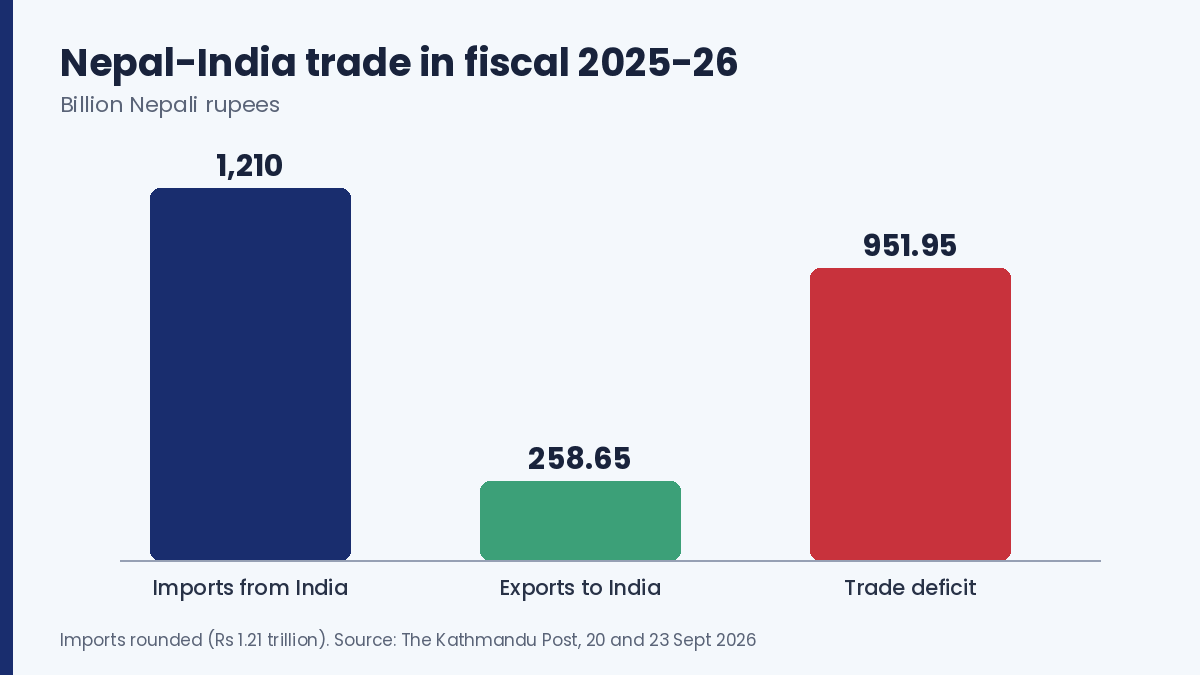
The balance, though, is heavily in India’s favour. Here are the fiscal 2025-26 figures reported by The Kathmandu Post.
| Nepal-India trade, FY 2025-26 | Amount (Nepali rupees) |
|---|---|
| Total trade | Over Rs 1.46 trillion |
| Nepal’s imports from India | Rs 1.21 trillion |
| Nepal’s exports to India | Rs 258.65 billion |
| Trade deficit | Rs 951.95 billion |
Refined soybean, palm and sunflower oil made up 57.59% of Nepal’s exports to India, the Post said. That leaves Nepal’s export earnings exposed to any change in India’s edible-oil import duties.
Steel is a sore point. India’s safeguard duty on some steel imports, set at 12% from December 2025, helped push Nepal’s steel exports down by 62.43% in 2025-26, to Rs 6.14 billion, The Kathmandu Post reported. Nepal estimates a loss of more than Rs 10 billion a year in export earnings, and India has asked for a trade-remedies investigation before easing the curbs.
In September, officials agreed to review the Nepal-India trade treaty and to form a technical committee within six months. Nepal wants the review to cover non-tariff barriers, services and digital trade.
The Lipulekh row and other friction
The hardest issue is the border. Nepal claims Limpiyadhura, Lipulekh and Kalapani; India considers them part of Uttarakhand.
In May 2026, Nepal objected to India running the Kailash Mansarovar Yatra through the Lipulekh Pass. MEA spokesperson Randhir Jaiswal replied that Nepal’s claims were not justified or based on historical facts, and called the “unilateral artificial enlargement” of claims untenable, News On AIR reported. He said the route has been used since 1954, and that India stays open to dialogue on agreed boundary issues.
In June, Shah told Nepal’s Parliament that Kathmandu had engaged India, China and Britain on the matter, Outlook reported. India replied that a third party has no role in a bilateral issue and said about 98% of the boundary has been demarcated. A Nepali government spokesperson later said Shah’s remarks had been misinterpreted.
Shah’s past also draws attention in India. As mayor in 2023, he displayed a “Greater Nepal” map in his office and briefly banned Indian films in Kathmandu over a line in Adipurush, Wikipedia records. As Prime Minister, his government tightened tariff rules on Indian goods worth more than Rs 100 from April 2026. Nepal also wants a review of the 1950 Treaty of Peace and Friendship.
What it means for India
For India, the visit is a chance to reset ties with a new and popular leader early in his term. A steady, friendly Nepal matters for the open border, for Nepalis who work in India and send money home, and for pilgrims who cross both ways.
The energy deal is the clearest win-win. Nepali hydropower gives India clean electricity, while sales to India give Nepal one of its few large export earners.
There is also a strategic angle. Outlook noted China’s growing influence in Nepal, and New Delhi will want to show that it remains Kathmandu’s most useful partner on trade, transit and investment. How warmly Shah speaks at the joint press conference, and whether Lipulekh comes up in public, will be read closely in both capitals.
What happens next
The main outcomes should be clear by this evening: the joint press conference, any joint statement, the list of MoUs, and the projects opened or started by video link. The size of any economic package is the number to watch.
After that, the work moves to officials. The technical committee on the trade treaty is due within six months of September’s meeting, and the steel and jute curbs depend on India’s trade-remedies process. The border question has no timetable, but today will show whether both sides choose to keep it out of the spotlight.
FAQ
Why is Nepal PM Balen Shah visiting India?
He is on a two-day state visit on 22-23 November 2026 at PM Modi’s invitation, his first bilateral trip abroad since becoming Prime Minister in March. The talks cover trade, energy, connectivity, investment and the wider relationship.
How old is Balen Shah?
He was born on 27 April 1990, so he is 36. Outlook describes him as Nepal’s youngest Prime Minister.
Which party does Balen Shah belong to? He belongs to the Rastriya Swatantra Party, which he joined on 28 December 2025. The party won a landslide in the 2026 election, and he defeated K.P. Sharma Oli in Jhapa-5.
How much electricity does India buy from Nepal?
About 1,200 MW under a long-term arrangement that envisages up to 10,000 MW over ten years, Outlook reported. Nepal earned roughly Rs 1,800 crore (Nepali rupees) from net power exports in 2025-26.
What is the Lipulekh dispute between India and Nepal?
Nepal claims Limpiyadhura, Lipulekh and Kalapani, which India treats as part of Uttarakhand. The issue flared again in May 2026 when Nepal objected to the Kailash Mansarovar Yatra passing through Lipulekh, and India called Nepal’s claims unjustified.
What is Nepal’s trade deficit with India?
Nepal’s deficit with India was Rs 951.95 billion (Nepali rupees) in fiscal 2025-26, on total bilateral trade of over Rs 1.46 trillion, The Kathmandu Post reported.
Did Balen Shah study in India?
Yes. Wikipedia records that he earned an M.Tech in structural engineering from Visvesvaraya Technological University in Karnataka.
Sources and fact-check notes
All pages below were opened on 23 November 2026.
- Outlook: Nepal PM Balen Shah India visit explained (22 November 2026): 34-member delegation, agenda, 1,200 MW / 10,000 MW, NPR 1,800 crore, Arun-3, Ayodhya-Janakpur trial run, Raxaul-Kathmandu, UPI-FonePay, 80% of exports, one-third of FDI, Lipulekh and June row, 98% demarcated, 1950 treaty, China
- The Tribune: Nepal PM arrives for two-day India visit (22 November 2026): age 36, reception, delegation, programme, MoU areas, MEA quote
- Khabarhub: PM Balen Shah arrives in New Delhi (22 November 2026): 3:30 pm arrival, Jaishankar first meeting, programme
- Khabarhub: India sees Balen’s visit as opportunity (22 November 2026): MEA framing, Neighbourhood First
- Pratidin Time: Nepal PM meets Jaishankar (22 November 2026): Jaishankar meeting on arrival day
- Dainik Jagran English: Government events on 23 November: talks agenda for today
- Wikipedia: Balen Shah: birth date, education, rap career, mayoralty, RSP, Jhapa-5 result, appointment date, Greater Nepal map, Adipurush ban, April 2026 tariff rule
- The Kathmandu Post: Nepal, India agree to review treaty amid widening trade deficit (23 September 2026): FY 2025-26 trade figures, edible oil share, treaty review, technical committee
- The Kathmandu Post: Nepal lost Rs10 billion in India’s import squeeze (20 September 2026): steel safeguard duty, 62.43% fall, India’s demand for an investigation, over 60% share of trade
- News On AIR: India rejects Nepal’s objection to Kailash Mansarovar Yatra through Lipulekh (4 May 2026): Randhir Jaiswal’s response, route used since 1954