
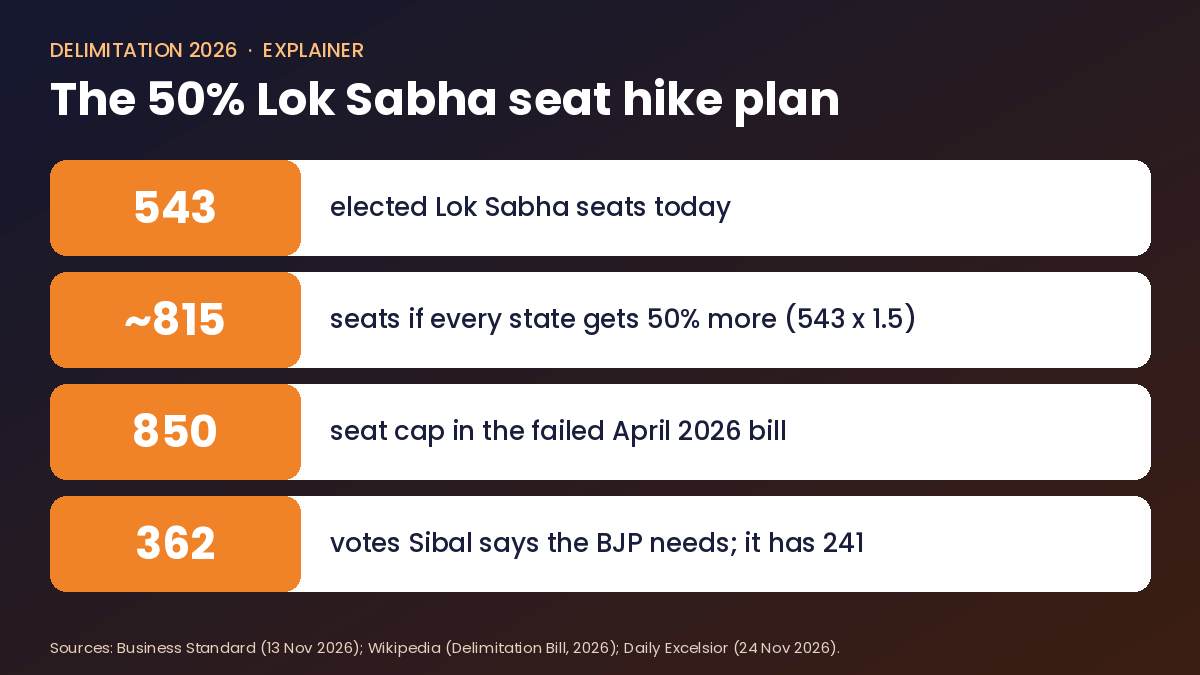
The delimitation 50% seat increase now being discussed would give every state half as many Lok Sabha seats again as it has today, keeping each state’s share of the House roughly where it is. The idea is back in the headlines after Rajya Sabha MP Kapil Sibal told a press conference in New Delhi on 24 November that opposition parties should not accept it, calling it a “sop”.
The plan follows a failed attempt earlier this year. In April 2026, a constitutional amendment that would have raised the Lok Sabha’s cap to 850 seats did not get the special majority it needed. The Centre now intends to call a special session of Parliament to bring fresh legislation, Business Standard reported on 13 November. Here is what is on the table, who gains, and why the debate splits largely along North-South lines.
Key points
- The Lok Sabha has 543 elected seats today; a uniform 50% rise would take it to roughly 815.
- In April 2026, the Constitution (131st Amendment) Bill, tied to the Delimitation Bill, 2026, failed to win the required majority in the Lok Sabha.
- The government is reported to be planning a special session to bring fresh legislation.
- Kapil Sibal says the BJP has 241 Lok Sabha MPs and needs 362 votes to pass an amendment.
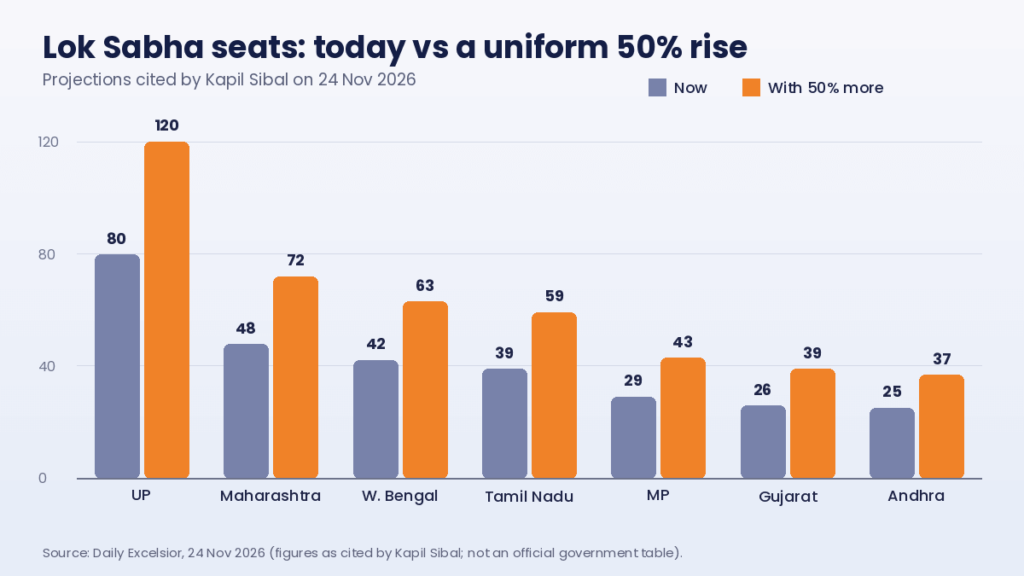
- Under his projections, Uttar Pradesh would go from 80 to 120 seats and Tamil Nadu from 39 to 59.
- Parliament’s Monsoon Session has not been formally closed since both Houses were adjourned on 13 August.
What is delimitation, and why now?
Delimitation is the process of fixing how many Lok Sabha and Assembly seats each state gets and redrawing the boundaries of constituencies. Under Articles 81 and 82 of the Constitution, representation is tied to population and to readjustment after each census.
That link has been on hold for decades. State-wise seat numbers still rest on the 1971 Census, a freeze that has kept the House at 543 elected members.
The freeze cannot last forever. A fresh census is due around 2027, and the women’s reservation law passed in 2023 cannot take effect until a delimitation based on new census figures is done.
The April bill that failed
On 16 April 2026, Law Minister Arjun Ram Meghwal introduced the Delimitation Bill, 2026 in the Lok Sabha. It proposed raising the House to as many as 850 members, with up to 815 from states and 35 from Union Territories.
The bill would also have let the Delimitation Commission start work before the 2027 census was complete. The government said this would speed up the one-third reservation of seats for women.
Home Minister Amit Shah told the House that southern states would not lose out: their seats would rise from 129 to 195, and their share would edge up from 23.76% to 23.87%. Congress MP Shashi Tharoor argued that tying delimitation to the women’s quota held women’s hopes hostage.
The key vote did not go the government’s way. The Constitution (131st Amendment) Bill, which carried the delimitation plan, failed to get the special majority in the Lok Sabha, and Business Standard reports that the April bills have since become infructuous.
The new idea: 50% more seats for every state
The option now being discussed is simpler. Instead of a fresh, population-based share-out, every state’s current tally would be raised by the same 50%.
The point of a uniform rise is that no state’s share falls. Southern states fear that a population-based count would shrink their share of seats, even if their absolute numbers held steady. A flat increase sidesteps that.
Business Standard set out what a population-based share-out within today’s 543 seats could look like. The table shows the contrast with a 50% uniform rise.
| State | Seats today | If 543 seats are reshared by population | With a uniform 50% rise |
|---|---|---|---|
| Uttar Pradesh | 80 | 89 | 120 |
| Bihar | 40 | 46 | 60 |
| Tamil Nadu | 39 | 32 | 59 |
| Kerala | 20 | 15 | 30 |
The first two columns come from Business Standard; the 50% column is simple arithmetic on today’s seats. For Uttar Pradesh and Tamil Nadu, the 50% figures match those Kapil Sibal cited.
The idea is not new this month. In July, Madhyamam reported, citing The Wire, that the Centre was preparing a revised plan with a uniform 50% rise, and that the Telugu Desam Party, a BJP ally, had backed it.
A separate working paper by the Economic Advisory Council to the Prime Minister has suggested a “targeted” route: splitting 170 large constituencies into two or three parts to take the House to 824 seats.
What Kapil Sibal said
Sibal’s objection is less about the arithmetic and more about who it helps. At his 24 November press conference, he argued that a uniform 50% rise favours the populous northern states where the BJP is strong, because they already have the most seats.
He warned opposition parties that democracy “will not survive” if they accept the offer, according to Daily Excelsior. He also cited these projections:
- Uttar Pradesh: 80 to 120
- Maharashtra: 48 to 72
- West Bengal: 42 to 63
- Tamil Nadu: 39 to 59
- Madhya Pradesh: 29 to 43
- Gujarat: 26 to 39
- Andhra Pradesh: 25 to 37
Sibal also criticised the government for not announcing a Winter Session while keeping the Monsoon Session open. Both Houses were adjourned indefinitely on 13 August, and the session has not been prorogued since, which he said broke the 2008 record of 87 days. A fresh session needs at least 14 days’ notice, he noted, while an extra sitting of an existing session needs only two.
These figures and claims are Sibal’s; the government has not published an official seat table for the uniform plan.
Why the numbers matter
A constitutional amendment needs a special majority: a majority of the total membership of each House, and two-thirds of members present and voting. That is why the vote count dominates the debate.
Sibal put the BJP’s strength at 241 and the target at 362. Government sources, The Hindu reported and Business Standard noted, are confident of 15 to 16 votes more than needed this time. Madhyamam’s July report also pointed to defections from opposition parties that have added to the ruling NDA’s numbers.
The math cuts both ways. A uniform rise keeps the southern share stable, which may win over some regional parties, but it also locks in the North’s large absolute lead in seats.
The women’s reservation link
The Constitution (106th Amendment) Act, 2023, the women’s reservation law, sets aside one-third of seats in the Lok Sabha and state Assemblies for women. But Article 334A ties its start to the publication of census figures and the delimitation that follows.
The April proposal tried to remove that condition so reservation could start sooner. Any fresh bill will have to decide again whether to keep women’s reservation tied to the census or to the new seat plan.
What happens next
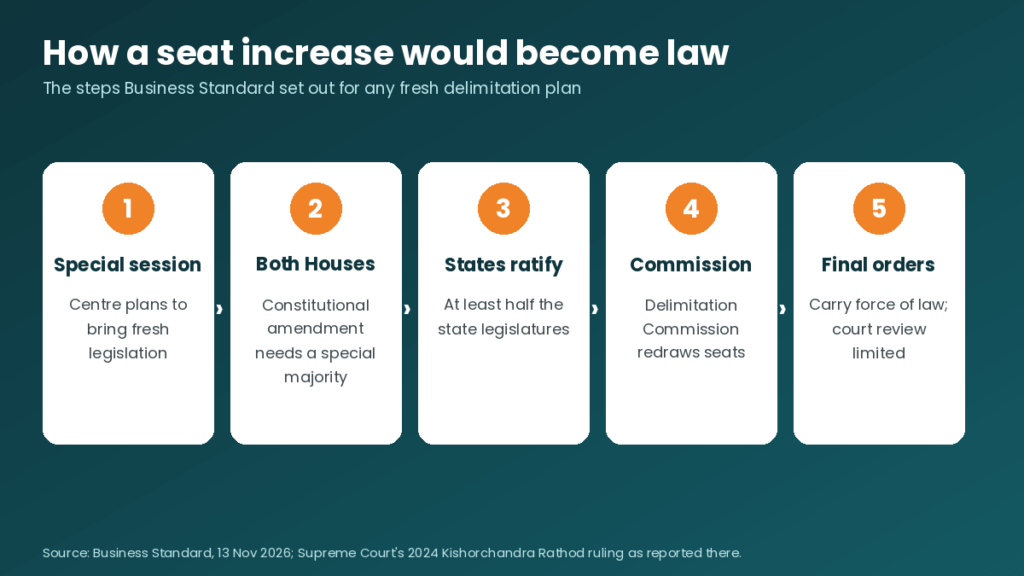
Business Standard listed the steps any new plan would have to clear:
- Fresh legislation, likely in a special session of Parliament.
- A constitutional amendment passed by both Houses with a special majority.
- Ratification by at least half the state legislatures.
- A Delimitation Commission to redraw constituency boundaries and fix seats.
- Final delimitation orders, which carry the force of law.
Courts usually stay out of delimitation orders, but the Supreme Court’s 2024 ruling in the Kishorchandra Chhanganlal Rathod case held that this immunity is not absolute, Business Standard noted.
For now, there is no date for a special session and no official seat table for the 50% plan. Watch for a session notice from the government, statements from southern parties, and whether the opposition holds together on the vote.
FAQ
What is the 50% seat increase plan in delimitation? It is an option under discussion to raise every state’s Lok Sabha seats by the same 50%, instead of resharing seats by population. It would keep each state’s share of the House roughly unchanged.
How many Lok Sabha seats would there be after a 50% increase?
A 50% rise on today’s 543 elected seats works out to roughly 815. The failed April 2026 proposal had set a cap of 850 members, including up to 35 from Union Territories.
Why did the Delimitation Bill 2026 fail?
The Constitution (131st Amendment) Bill, which the Delimitation Bill depended on, did not get the special majority it needed in the Lok Sabha in April 2026. Business Standard reports those bills have become infructuous.
Why is Kapil Sibal opposing the 50% seat hike?
Sibal says a uniform rise favours populous northern states where the BJP is strong, and he called it a “sop” meant to win opposition votes. He warned opposition parties not to accept it.
How many seats would Uttar Pradesh and Tamil Nadu get?
With a uniform 50% rise, Uttar Pradesh would go from 80 to 120 and Tamil Nadu from 39 to 59, as cited by Kapil Sibal. No official seat table has been published.
What does delimitation have to do with women’s reservation?
The 2023 women’s reservation law reserves one-third of Lok Sabha and Assembly seats for women, but it starts only after fresh census figures and delimitation. Any new seat plan will decide how soon reservation can begin.
When will Parliament take up the new delimitation bill?
The Centre is reported to be planning a special session, but no date had been announced as of 25 November 2026.
Sources and fact-check notes
All pages below were opened on 25 November 2026.
- Daily Excelsior: ‘Democracy won’t survive’: Sibal warns opposition (24 Nov 2026): Sibal’s remarks, BJP 241 / 362 figures, state projections, Monsoon Session adjourned 13 Aug, 87-day record, notice periods
- Business Standard: Why seat expansion has revived the North-South debate (13 Nov 2026): failure of the 131st Amendment, special session plan, 15-16 vote margin (citing The Hindu), seat figures, Articles 81-82, women’s reservation link, steps ahead, Rathod ruling
- Wikipedia: Delimitation Bill, 2026: introduction on 16 Apr 2026, 850 / 815 / 35 seats, Amit Shah’s 129-to-195 and share figures, Tharoor’s remark
- Madhyamam: Centre weighs fresh delimitation plan with uniform 50% increase (7 Jul 2026): uniform 50% plan (citing The Wire), TDP support, EAC-PM paper (824 seats, 170 constituencies), defections
- Indian Opinion: Today in India, 24 November 2026: confirms the story among the day’s top national headlines
- Google Trends India, trending now: checked for the day’s trending searches (mostly cricket and football; no non-sport national story stood out, so the day’s top policy headline was chosen)