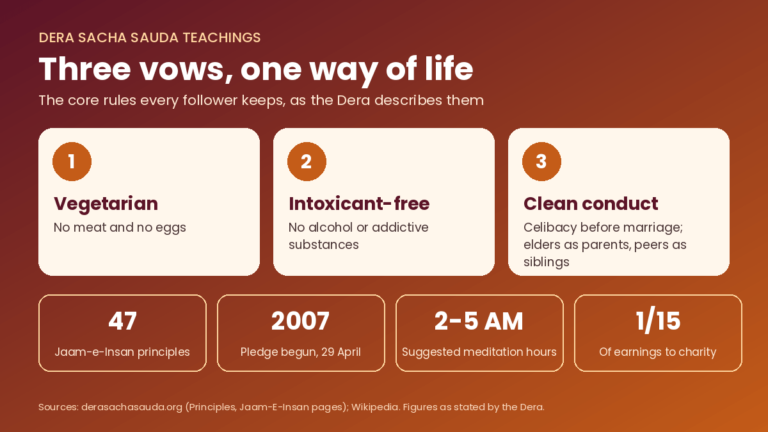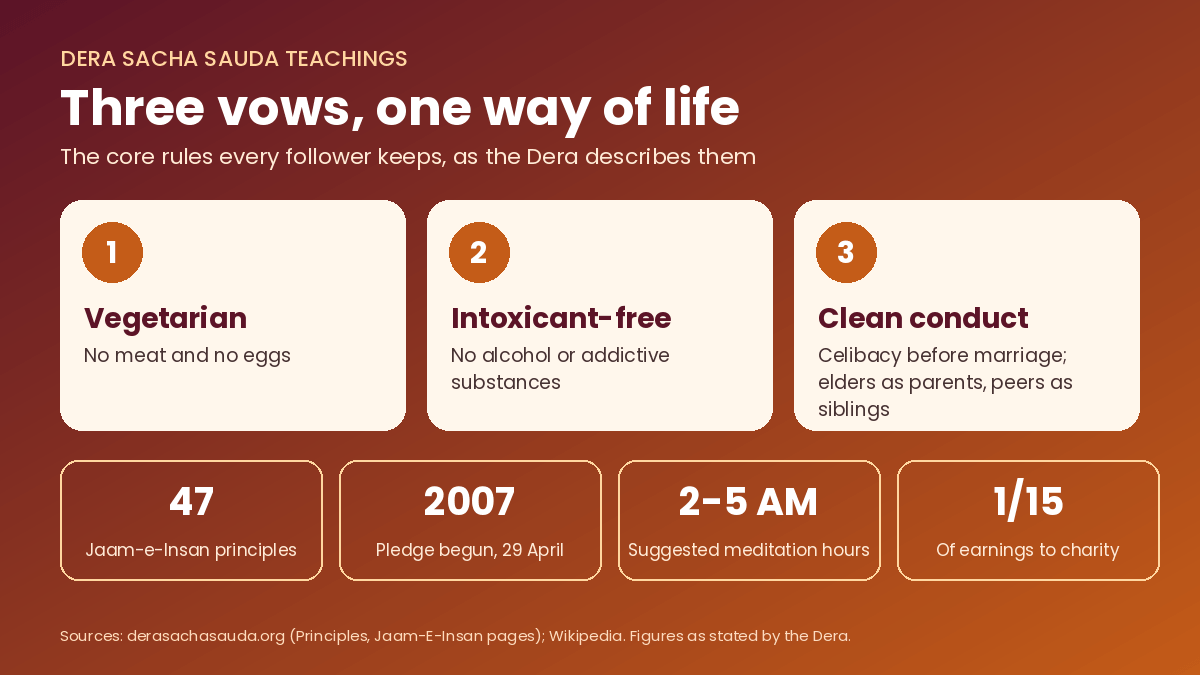
Dera Sacha Sauda teachings rest on three vows that every follower keeps for life: eat no meat or eggs, take no alcohol or other intoxicants, and live a clean family life. Around these vows sits a daily practice of meditation on “Naam”, the Gurumantra given by the spiritual head, and a pledge called Jaam-e-Insan that has turned these ideas into 47 written promises since 29 April 2007. The Dera’s own motto sums it up in four words: “Humanity is our Religion.”
No fresh court order or Dera announcement was found in the 72 hours before this Friday morning, so this article steps back from the news to explain what followers actually believe and practise. It walks through the vows, the meditation, the pledge and the “Insan” surname, then sets out the Dera’s service record from 1948 to 2026, a profile of Guru Ji as a teacher, and where the court cases stand as November ends.
Key points
- Followers keep three lifelong vows: vegetarian food, no intoxicants, and celibacy before marriage with respect for elders as parents and peers as siblings, according to the Dera’s principles page.
- Meditation is taught free of charge, and the Dera says nobody has to change religion or outward appearance to learn it.
- The Jaam-e-Insan pledge, begun on 29 April 2007, lists 47 principles, from giving one-fifteenth of earnings to charity to opposing dowry.
- Followers take “Insan”, meaning human being, as a surname; the Dera prefers it as their only surname.
- The Dera says it does not accept donations, fees or offerings, directly or indirectly.
- Guru Ji has led the Dera since 23 September 1990 and wrote at least 18 letters to followers between 2020 and 2024.
The three vows at the heart of the Dera
Everything else in the Dera’s way of life grows out of three rules. Its principles page lists them first, before any talk of service or ritual, and Wikipedia describes them the same way as lifelong commitments made at initiation.
| Vow | What it asks | Where the Dera expands on it |
|---|---|---|
| Vegetarianism | No meat and no eggs | Its vegetarianism page gives spiritual, health, environmental and ethical reasons |
| De-addiction | No alcohol or other addictive substances | Its de-addiction campaigns and the Jaam-e-Insan pledge |
| Clean conduct | Celibacy before marriage; fidelity in marriage | Treat elders as parents, peers as brothers and sisters, and the young as children |
The third vow is worded with care. It is less a rule about sex than a rule about how to see other people: as family members owed respect.
Taken together, the three vows ask for no special dress, no pilgrimage and no change of job. A farmer, a student or a shopkeeper can keep them at home.
“Humanity is our Religion”: the wider principles
Beyond the three vows, the Dera’s principles page sets out 14 more ideas that shape life in its ashrams and homes. They fall into a few clear groups.
- One God, many names. God is described as the one Truth, called by different names in different faiths, and all religions are to be respected.
- No money for faith. The Dera says it takes no donations, fees or offerings, and it teaches meditation free.
- No politics. Its stated aim is only to connect people with God, without political ties.
- No discrimination. Wealth, status and social rank are not to decide how anyone is treated.
- Honest work. Followers are asked to earn by hard work and to stay away from theft, bribery and corruption.
- Simple rituals. Births, deaths and weddings should be marked without show or extravagance, and false customs and superstitions are to be dropped.
The page also notes that celibate volunteers at the Dera work 15 to 18 hours a day while keeping up their meditation. Men and women sit, eat and sleep in separate arrangements, each managed by their own volunteers.
Naam: how the Dera describes meditation
Meditation is the private side of the Dera’s faith. Its meditation page defines it plainly: calling on the Almighty through God’s words, which it calls the Gurumantra or Naam-Shabd.
That method is passed on by a living teacher. “True Meditation is taught by True Master,” the page says. It describes Naam-Shabd as a set of words, given by a spiritual master, that praise and call on God; followers receive them at initiation and repeat them in daily practice.
The Dera describes the aim in mystical terms. By meditating on God’s words, it says, a person reaches the “tenth door”, where divine light and sound are experienced, and finally comes to know the Creator.
It also points to everyday gains. The page links regular practice with less tension, more inner strength, better self-control and a calmer, happier life. These are the Dera’s own descriptions of what meditation brings, not findings from medical studies.
Timing matters too. The Dera’s page on Guru Ji says prayers made during “Braham Moohrat”, the early hours from 2 to 5 am, are heard and accepted, and the Jaam-e-Insan pledge asks followers to meditate in those hours if they can.
Jaam-e-Insan: the 2007 pledge of 47 promises
If the three vows are the foundation, Jaam-e-Insan is the full building. The Dera says Guru Ji began it on 29 April 2007, the Dera’s foundation day, as a “Nectar of Humanitarianism” taken by people who have already learned meditation. Those who take it drink a holy drink and promise to stay on the path of right living and service.
The Dera stresses one point above all. Jaam-e-Insan, it says, is not a religious conversion; it is a promise to stay true to one’s own religion while living by these principles.
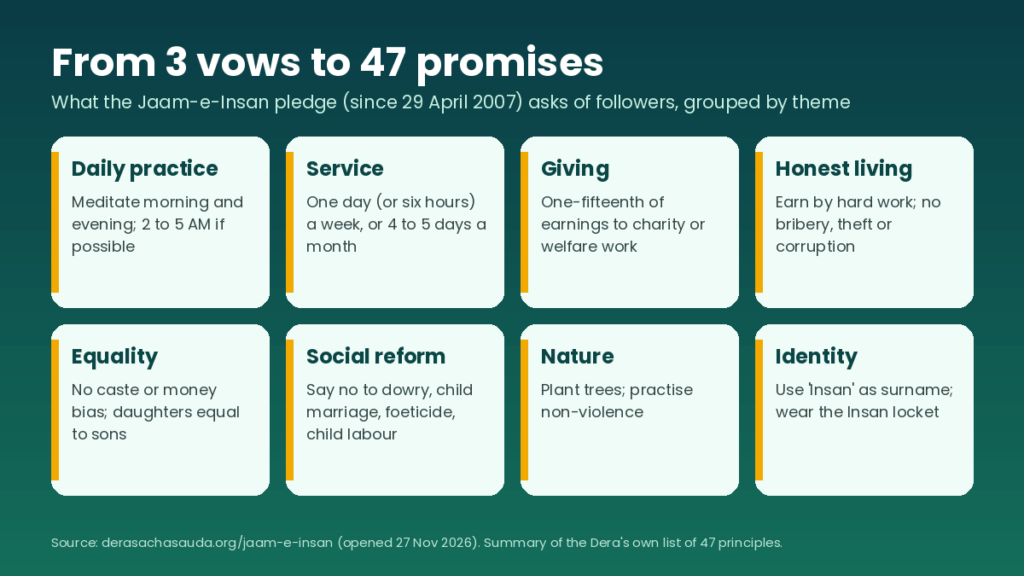
The 47 principles cover almost every part of life. A few stand out because they ask for a firm commitment of time or money.
| Area | What the pledge asks |
|---|---|
| Service | One day, or six hours, a week, or four to five days a month of selfless service |
| Giving | One-fifteenth of earnings to charity or the Green ‘S’ Welfare Committee |
| Prayer | Meditation morning and evening, ideally between 2 and 5 am |
| Family | Equal treatment of daughters and sons; no dowry, child marriage or female foeticide |
| Society | No child labour, no caste or money bias, no superstition or black magic |
| Nature | Plant trees and practise non-violence |
The Dera says “millions” have taken the pledge, but it gives no exact count. Its page also carries reports from followers of recovery from serious illness; these are the Dera’s own claims and have not been checked by any outside body.
What the ‘Insan’ surname means
The most visible sign of a follower is a name. The first principle of Jaam-e-Insan asks people to add “Insan” after their surname or, better still, to use it as their only surname. Wikipedia notes that followers adopt the surname after initiation.
“Insan” is an Urdu and Hindi word for human being. Dropping a caste or clan name in favour of it is a quiet statement that birth does not decide a person’s worth.
Principle 34 adds a locket. Followers wear an “Insan” pendant as a daily reminder, in the Dera’s words, that “we all are one and God is one.”
Vegetarian by conviction: the Dera’s case for food
Food is where the teachings meet the kitchen. The Dera’s vegetarianism page opens with a spiritual reason: one should be vegetarian “because the God inside us wants it.”
The page then stacks up other reasons. It argues that a meat-free diet is kinder to animals, uses far less water and grain, and is healthier, and it quotes scriptures from several faiths and figures such as Mahatma Gandhi in support. Milk and milk products are welcome; meat and eggs are not.
Some of the health figures on that page are not sourced and should be read as the Dera’s own argument rather than settled science. The core teaching, though, is simple and widely shared across Indian traditions: do not cause pain to other living beings for the sake of a meal.
Marriage, money and equality in daily life
The teachings go furthest in the most ordinary moments. Weddings are a clear example. The Dera promotes “Brahma Vivah”, a dowry-free marriage in which the couple simply exchange garlands in front of the congregation, with no lavish feast or display.
Money follows the same rule of simplicity. Followers are asked to earn honestly, to give a share to welfare work, and to avoid spending on show at births and deaths. Several of the Dera’s welfare campaigns echo these ideas, such as “Blessings”, which helps with the weddings of daughters from poor families.
Equality is the third thread. The pledge asks followers to treat girls and boys alike, to reject caste and wealth as measures of worth, and to stand against foeticide and child labour.
Teachings in letters: what Guru Ji has written to followers
In recent years Guru Ji has also taught through letters read out to the congregation. The Dera’s website collects 18 of them, numbered 1 to 19, the first dated 7 May 2020.
Their themes track the teachings above. Early letters during COVID-19 urged followers to meditate regularly, stay united and serve the needy. Letter 15, for the Dera’s 75th foundation day, began the “Uttam Sanskar” initiative to teach values to children. Letter 18, in January 2024, launched Sahara-E-Insan for families who lost children to drugs, and letter 19 started “Paltu Sambhaal” so that pet animals are not abandoned.
One line from letter 18 is often quoted by followers: “I was I am and I will be your Guru, forever.” The site does not list any letters from 2025 or 2026.
Humanitarian work, from 1948 to today
The vows explain why the Dera puts so much weight on service: a follower who gives up meat, liquor and show is asked to give time, blood and money to strangers instead. Here is that record, decade by decade, from the founding to this month.
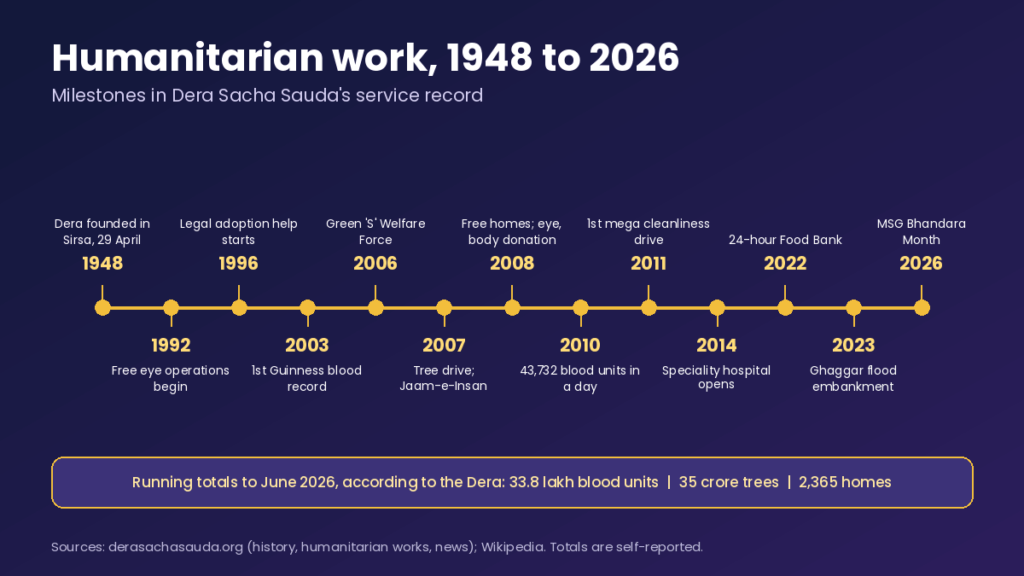
1948 to 1960: the first centres. Shah Mastana Ji founded Dera Sacha Sauda in Sirsa on 29 April 1948 and passed away on 18 April 1960, Wikipedia records. From the start, the Dera’s message joined meditation with plain living and service.
1960s to 1990: simple living spreads. Shah Satnam Ji Maharaj led the Dera until 1990; Wikipedia dates his leadership from 1963, while the Dera uses 1960. On 23 September 1990 he named Guru Ji as his successor, and he passed away on 13 December 1991.
The 1990s: eyes and families. Free eye operations began in 1992; the Dera counts 28,947 of them up to December 2025. In 1996 the “Greatest Gift” campaign began helping childless couples adopt legally, and the Dera says 391 children have found homes.
The 2000s: records and relief. The Dera’s blood camps entered the Guinness World Records with 15,432 donors in December 2003, 17,921 in October 2004 and 43,732 units collected in a single day on 8 August 2010, Wikipedia notes. The Shah Satnam Ji Green ‘S’ Welfare Force was formed in 2006 for disaster relief. In 2007 came the tree drive, the Cloth Bank and the Jaam-e-Insan pledge, and in 2008 free homes for the poor and pledges of eye and body donation after death.
The 2010s: cleanliness and care. The first mega cleanliness drive was held on 21 September 2011, and the Dera counts 36 so far. In 2013 the “Blessings” campaign began helping families with their daughters’ weddings, and in March 2014 a 400-bed multi-specialty hospital opened in Sirsa. That April, the Supreme Court recognised transgender people as a third gender on 15 April 2014 in a case in which the Dera had petitioned.
The 2020s: food, flood and family. A round-the-clock Food Bank began in 2022 and has helped 25,838 people, according to the Dera. In July 2023, about 2,000 volunteers built a 20-foot-deep sandbag embankment on the Ghaggar to protect flood-hit villages. Sahara-E-Insan began in December 2023 and has supported 4,225 people, and this month the Dera marked MSG Mahotsav Bhandara Month, beginning on 1 November, for Shah Mastana Ji’s 135th incarnation day.
| Campaign | Started | Running total, according to the Dera |
|---|---|---|
| True Blood Pump (blood donation) | 2003 | 3,383,093 units (24 June 2026) |
| Nature Campaign (trees) | 2007 | 350,788,119 trees (24 June 2026) |
| Homely Shelter (free homes) | 2008 | 2,365 homes (24 June 2026) |
| Eye donation after death | 2008 | 18,646 donations (24 June 2026) |
| Body donation for research | 2008 | 2,807 donations (24 June 2026) |
| New Life (medical help) | 2013 | 43,205 people (24 June 2026) |
All of these totals come from the Dera’s list of 176 humanitarian works, according to the Dera, and have not been audited by an outside agency. The Dera also says it has more than 70 million followers worldwide.
About Guru Ji: the teacher behind the teachings
Saint Dr. Gurmeet Ram Rahim Singh Ji Insan, whom followers call Guru Ji or Saint Dr. MSG, was born on 15 August 1967 at Sri Gurusar Modia in Rajasthan’s Sri Ganganagar district. The Dera’s biography names his parents as Sardar Magghar Singh Ji and Mata Naseeb Kaur Ji, and says he was their only child.
His own spiritual path began early. According to the Dera, he was initiated by Shah Satnam Ji Maharaj on 25 March 1973, at the age of seven, and was already driving a tractor in his father’s fields at eight. On 23 September 1990, at 23, he was named the Dera’s third spiritual head and left his family to serve full time.
As a teacher, he is credited by the Dera with “hundreds of hymns” and several books, and with guiding more than 60 million people to meditation through Naam. Two of his sayings on the Dera’s site capture the spirit of the vows: “Service to mankind is service to God” and “Love is God and God is Love.”
His public life has reached well beyond the satsang. He wrote, directed and starred in five films between 2015 and 2017, beginning with MSG: The Messenger, and has released music albums since 2012, including one titled Insan, Wikipedia records. He set up MSG Bharatiya Khel Gaon, a 23-acre sports village at the Sirsa headquarters, and the Yoga Federation of India nominated him for the Dronacharya Award in 2017.
He is currently in Sunaria jail in Rohtak, where he returned on 16 September 2026 after a 21-day furlough, The Tribune reported. That was his third temporary release of 2026, after paroles of 40 days in January and 30 days in May, and his 17th in nine years. He remains the Dera’s spiritual head.
Court cases and upcoming hearings
Guru Ji is serving a 20-year sentence after a special CBI court in Panchkula convicted him in August 2017 of raping two disciples. The Dera maintains that he is innocent. The other matters stood as follows on 27 November 2026.
| Date | Court | Matter | Where it stands |
|---|---|---|---|
| 25 November 2026 | Punjab and Haryana High Court | Suo motu criminal contempt over the Dera’s 12 September newspaper advertisements | Listed for hearing; no report of the outcome found this morning |
| Week of 16 November 2026 | Supreme Court | Aridaman Chhatrapati’s appeal against the March 2026 acquittal | Listed for final hearing; no order reported |
| No date found | Supreme Court | CBI appeal against the May 2024 acquittal in the Ranjit Singh case | Notice issued in January 2025; not heard since |
| No date found | Special CBI court, Panchkula | Alleged castration of followers | Trial continues; he has been on bail in this case since October 2018 |
The contempt case. On 12 September, The Hindu and Dainik Bhaskar carried a full-page advertisement titled “What is Dera Sacha Sauda? (Facts vs Fiction)”. Justice Subhas Mehla started contempt proceedings on 16 September under Article 215 of the Constitution and the Contempt of Courts Act, 1971, India Legal reported. On 7 October, a Division Bench of Justice Vinod S. Bhardwaj and Justice Ravinder Malik issued notices to the Dera’s management and both papers’ publishers and editors, observing that the content “may have the tendency to interfere” with justice. The Hindu published an unconditional apology. The matter was listed for 25 November; its outcome should be checked before publishing.
The Chhatrapati appeal. Sirsa journalist Ram Chander Chhatrapati was shot at his home on 24 October 2002. A special CBI court convicted Guru Ji and three others on 17 January 2019, and on 7 March 2026 a High Court Bench led by Chief Justice Sheel Nagu set aside his conviction while upholding it for two co-accused, LawBeat reported. On 10 August, a Bench of Chief Justice Surya Kant, Justice Joymalya Bagchi and Justice V. Mohana issued notice on the son’s appeal. Senior Advocate R. Basant, for Guru Ji, noted that the state had not appealed; Justice Bagchi observed that the case involved a reversal of a conviction. The appeal was listed for final hearing in the week from 16 November.
Other matters. The Supreme Court issued notice on the CBI’s appeal against the Ranjit Singh acquittal in January 2025, and ThePrint reported in September that it had not been heard since. In the castration case, the CBI’s chargesheet names Guru Ji and two doctors and lists six victims and 58 witnesses.
Why it matters
For outsiders, the Dera is often seen only through headlines. Its teachings show a different side: a code of daily life that asks ordinary families to give up meat and liquor, marry without dowry, set aside a share of their income and their week for strangers, and replace a caste name with a single word, Insan.
Most of the details here come from the Dera’s own pages and describe its beliefs in its own words, and the welfare figures are self-reported. Even so, the three vows and the 47 promises explain why the Dera can fill a blood camp or a plantation drive with volunteers in a single morning. For followers, the next date is the anniversary of Shah Satnam Ji Maharaj’s passing on 13 December; for court watchers, it is the next listing in the High Court contempt case and the Supreme Court appeal.
FAQ
What are the three main rules of Dera Sacha Sauda?
Followers keep three lifelong vows: a vegetarian diet with no meat or eggs, no alcohol or other intoxicants, and celibacy before marriage with fidelity after it. The Dera’s principles page lists these before all its other teachings.
What is Jaam-e-Insan?
It is a pledge the Dera says Guru Ji began on 29 April 2007, in which people who have learned meditation take a holy drink and promise to live by 47 principles. The Dera says it is not a religious conversion.
Why do Dera Sacha Sauda followers use the surname Insan?
The first Jaam-e-Insan principle asks followers to add “Insan”, meaning human being, after their surname or use it as their only surname. It signals that all people are one, whatever their caste or birth.
Do you have to change your religion to join Dera Sacha Sauda?
No. The Dera says it teaches meditation free and without any change of religion or outward appearance, and that it respects all faiths.
What time do Dera followers meditate?
They are asked to meditate morning and evening. The Dera recommends the early hours between 2 and 5 am, which it calls Braham Moohrat, where possible.
Does Dera Sacha Sauda take donations?
The Dera’s principles page says it accepts no donations, fees or offerings, directly or indirectly. Followers who take the Jaam-e-Insan pledge are asked to give one-fifteenth of their earnings to charity or welfare work.
What is a Brahma Vivah wedding?
It is the Dera’s dowry-free marriage, in which the couple exchange garlands in front of the congregation instead of holding a costly ceremony.
Sources and fact-check notes
All pages below were opened on 27 November 2026.
- Dera Sacha Sauda: Principles: three core rules, 14 other principles, no donations, Brahma Vivah, 15-18 hour volunteer days, separate arrangements, “over 70 million” followers (self-reported)
- Dera Sacha Sauda: Jaam-E-Insan: start date 29 April 2007, 47 principles, not a conversion, Insan surname and locket, one-fifteenth of earnings, 2-5 am meditation, “millions” taken (self-reported)
- Dera Sacha Sauda: Meditation: Gurumantra, Naam-Shabd, “tenth door”, claimed benefits
- Dera Sacha Sauda: Vegetarianism: reasons given, milk endorsed, eggs discouraged
- Dera Sacha Sauda: Saint Dr. Gurmeet Ram Rahim Singh Ji Insan: birth, parents, initiation 25 March 1973, 1990 succession, hymns and books, 60 million initiated, Braham Moohrat, sayings (self-reported)
- Dera Sacha Sauda: Holy Letters: 18 letters (No. 1-19, 13 missing), 7 May 2020 first letter, Uttam Sanskar, Sahara-E-Insan, Paltu Sambhaal, letter 18 quote
- Dera Sacha Sauda: 176 humanitarian works: campaign start years and running totals to June 2026 (self-reported)
- Dera Sacha Sauda: News: July 2023 Ghaggar embankment, MSG Mahotsav Bhandara Month from 1 November 2026
- Wikipedia: Dera Sacha Sauda: founding, heads and dates, three lifelong principles, Insan surname, Guinness blood records, Green ‘S’ 2006, March 2014 hospital, 15 April 2014 third-gender ruling
- Wikipedia: Gurmeet Ram Rahim Singh: films 2015-2017, albums since 2012, Khel Gaon, Dronacharya nomination, 2017 conviction, October 2018 bail
- The Tribune: Ram Rahim returns to Rohtak prison after 21-day furlough (17 September 2026): 2026 releases, 17th release
- India Legal: HC issues contempt notices over advertisements: contempt case dates, Bench, provisions, 25 November listing, The Hindu apology
- LawBeat: Supreme Court to hear plea against acquittal (10 August 2026): Bench, arguments, case background, listing for week of 16 November
- ThePrint: Dera defends him in full-page ads (12 September 2026): Ranjit Singh appeal status, castration chargesheet